


Top 5 Garden Trends for 2023
With each passing year, gardening trends come and go. Some are fleeting, while others stick around for decades at a time. We’re going to look at five of the most popular trends in gardening right now and how they might impact your garden design plans for the future. From vertical gardens to modern features made from natural materials (like stone or wood), these ideas are sure to make an impact on your garden for years to come!
Vertical gardening

Vertical gardens are a great way to maximise space, whether you’re trying to fit a garden into an urban environment or just want to make the most of a small garden. Vertical gardens can be used indoors or outdoors, so they’re perfect for people who want to grow plants but don’t have access to any natural sunlight.
There are so many different ways to incorporate vertical elements into your garden. Trellis has long been used to grow climbing plants, however, we’re seeing increasing creativity as this trend grows. With people using horizontally slatted fencing and structures built from pallets to hang smaller plants, to complex irrigation systems being installed on walls for growing fruit and vegetables. The possibilities are endless!
Outdoor kitchens and lounges
Outdoor kitchens and lounges have become a popular addition to home gardens. These spaces can be used for cooking, dining and entertaining guests. Outdoor kitchens can be designed to fit into any space and can be customised based on the needs of your family or guests. Many people choose to erect a pergola to really turn the space into a feature. Pergolas are ideal for adorning with climbing plants, outdoor lighting and a multitude of other accessories.

Common features of an outdoor kitchen include a barbeque or pizza oven, countertop with seating, sink and bar area. Outdoor kitchens and lounges aren’t just great in the summer – they can also make a fun entertaining area in cooler months! With the simple addition of a fire pit or patio heater, you’ll really be able to make the most of this space for much of the year.
Modern features made of natural materials, such as stone and wood
As sustainability continues to gain momentum in so many aspects of our lives, 2023 will see an increase in sustainable, natural materials used in gardening. The use of hard landscaping and the materials involved can come with heavy carbon footprints.
“Cement – used to make concrete – contributes almost 1kg of carbon dioxide for every 1kg produced, although some is reabsorbed as concrete is exposed to the air. Bricks add 250g per 1kg, and every square metre of stone patio adds about 47.5kg of carbon dioxide, depending on the stone.”
As well as their environmentally friendly nature, the versatility of natural materials also makes them a popular choice. Used for everything from seating and tables, to stepping stones and raised beds, you can really get creative./
Container gardens
Whether you’re working with a small or large garden, or even just a patio or balcony, container gardening offers great flexibility when it comes to growing opportunities.
Container gardens are an excellent way to add colour and texture to your garden space. They’re also very easy to maintain as they don’t require much watering or pruning unlike other types of gardens.
A whole host of plants can be grown in containers, from hardy bedding plants to bulbs, herbs, fruit and vegetables and even shrubs and trees.
Pops of colour
Adding a pop of colour to your garden can really give it some personality. After all, gardens are meant to be colourful!
With Pantone naming Viva Magenta as their colour of the year 2023, why not add a splash to your garden? There are so many places to add colour, such as:
- Flowers and plants
- Containers and accessories
- Furniture
- A feature fence
Which 2023 trend will you incorporate into your garden?
Now we’ve given you some inspiration to take into Spring, which one will you be incorporating in your garden? The trend we’re most excited about is vertical gardening as it allows you to grow more plants in less space, and adds levels to your garden as they’re visible from above ground level. This can be done with trellis, or even just poles stuck into the ground with netting attached so that they support climbing vines like cucumbers or tomatoes.
FENCEMATE DuraPost – A Revolutionary New Fencing System
Made of galvanised steel, the FENCEMATE DuraPost System creates durable fencing that is quick to install. DuraPost is suitable for all the jobs where you might have used concrete or timber posts. The system is compatible with virtually all types of timber fencing panels including feather board, hit and miss, European panels and close boarded fencing.
What types of jobs is FENCEMATE DuraPost suitable for?
DuraPost is suitable for all the jobs where you might have used concrete or timber posts.
Why does DuraPost come with a continuous run of holes?
The continuous run of holes provided on the DuraPost allows you to fix your fence panel or gravel board from the rear of the post. The holes make it easier to construct your fence, particularly when building on a slope.
Which types of fencing is DuraPost suitable for?
DuraPost is suitable for virtually all types of timber fencing panels including feather board, hit and miss, European panels and close boarded fencing. The post can be used for post and rail fencing but is not designed for any type of wire fencing systems.
Is DuraPost really up to twice as quick as concrete to install?
A test was carried out using independent professional contractors. This demonstrated that the time taken to fit fence panels with DuraPost took only half the time in terms of man-hours when compared to concrete posts. One person was able to carry out the tasks normally requiring two people because DuraPost is so much lighter and easier to use than concrete posts.
Does FENCEMATE DuraPost really withstand high winds?
Yes. The product underwent independent testing at the Building Research Establishment and proved to withstand wind speeds in excess of 70MPH.
How sustainable is FENCEMATE DuraPost?
DuraPost is made from steel which is a sustainable material and can be infinitely recycled.
FENCEMATE DuraPost – Technical Specifications
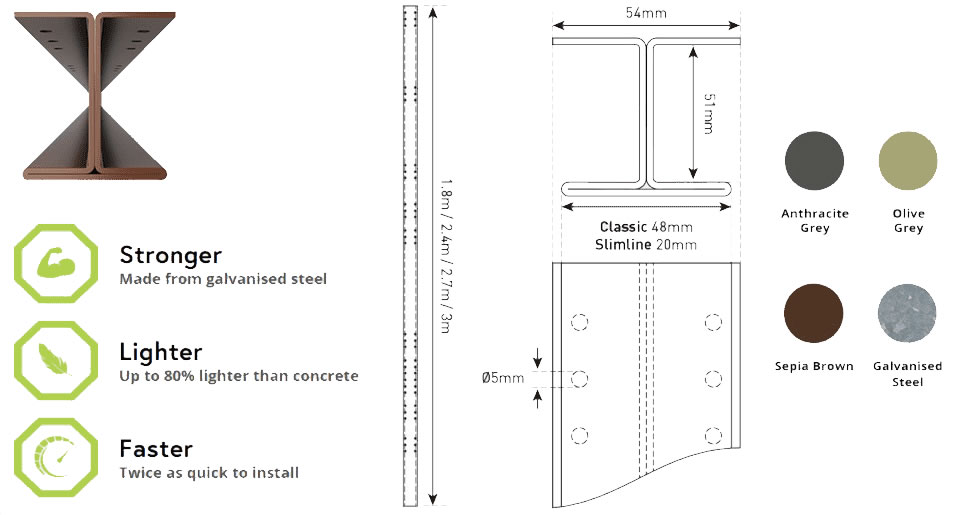
FENCEMATE DuraPost – Installation Instructions
Step 1:
Set your first post into the ground using Rapid Set Fence Post Concrete and check the height. Dig the next hole. You can now position the gravelboard at the correct height and checked for level.
Step 2:
Slide your fence panel into the first post and secure with screws. Position your second post, check for alignment and set into the ground.
Step 3:
Fix capping rail and post caps if required.

You can find the full range of FENCEMATE Durapost products on our website.
The Forest Stewardship Council runs a global forest certification system with two key components.
Forest Management
Forest Management Certification, which makes sure that the forest is managed to high standards covering social, environmental and economic issues.
Chain of Custody
Chain of Custody certification, which traces the wood from those forests through all stages of processing and distribution. Chain of Custody certification from forest to end-user ensures that FSC materials and products have been checked at every stage of processing so that customers purchasing FSC labelled products can be confident that they are genuinely FSC certified.
The 10 Forest Stewardship Council Principals
Compliance with Laws and FSC Principles
To comply with all laws, regulations, treaties, conventions and agreements, together with all FSC Principles and Criteria.
Tenure, Use Rights and Responsibilities
To define, document and legally establish long-term tenure and use rights.
Indigenous Peoples’ Rights
To identify and uphold indigenous peoples’ rights of ownership and use of land and resources.
Community Relations and Worker’s Rights
To maintain or enhance forest workers’ and local communities’ social and economic well-being.
Benefits from the Forest
To maintain or enhance long-term economic, social and environmental benefits from the forest.
Environmental Impact
To maintain or restore the ecosystem, its biodiversity, resources and landscapes.
Management Plan
To have a management plan, implemented, monitored and documented.
Monitoring and Assessment
To demonstrate progress towards management objectives.
Maintenance of High Conservation Value Forests
To maintain or enhance the attributes which define such forests.
Plantations
To plan and manage plantations in accordance with FSC Principles and Criteria.
For more information about the Forest Stewardship Council please visit them at www.fsc-uk.org/en-uk
HD Composite Decking is a low maintenance and durable alternative to timber. It combines traditional wood appearance with the latest in composite technology. Its long life, consistent colour and slip resistant properties are just a few reasons why it is becoming a direct replacement for both domestic and commercial decking applications. HD Deck is a composite made from responsibly managed 100% FSC® timber and both recycled and virgin high-density polyethene plastic. Keep reading to check out our comprehensive HD Composite Decking Fitting Guide.
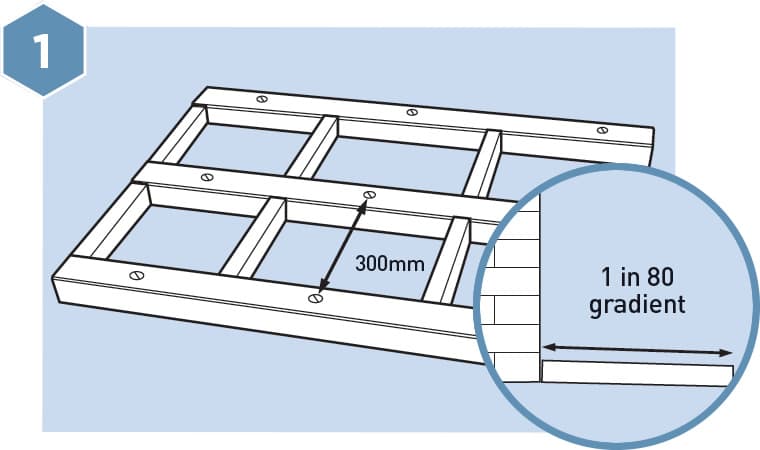
We recommend using treated 4″ x 2″ timber joists and building in a gradual gradient of at least 1 in 80 (1.25%) to help water naturally disperse down the length of the deck. The gradient should run away from adjoining buildings. IMPORTANT: Spacing between the joists should be no greater than 300mm between each joist.

Place the first piece of HD Composite Decking on the timber frame with the decking running perpendicular to the joists. The first piece of decking may be secured with end clips. Do not screw or nail through HD Composite Decking, use 1 clip and screw on every joist.
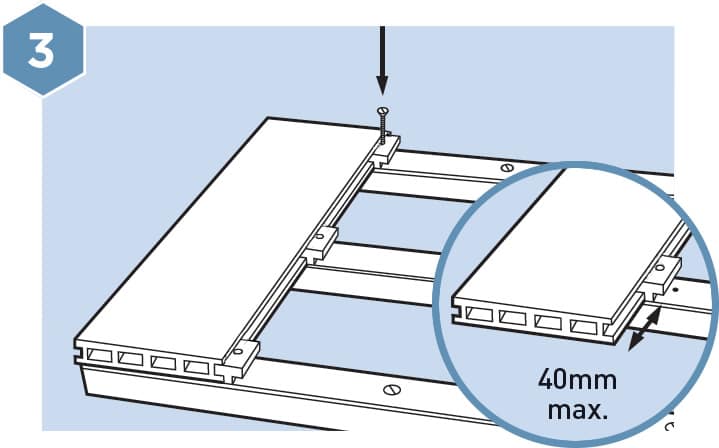
Take a screw, place in the hole located in the clip and screw into the wooden joist. Do not tighten at this stage. Make sure the boards do not overhang the joist at the edge by more than 40mm.
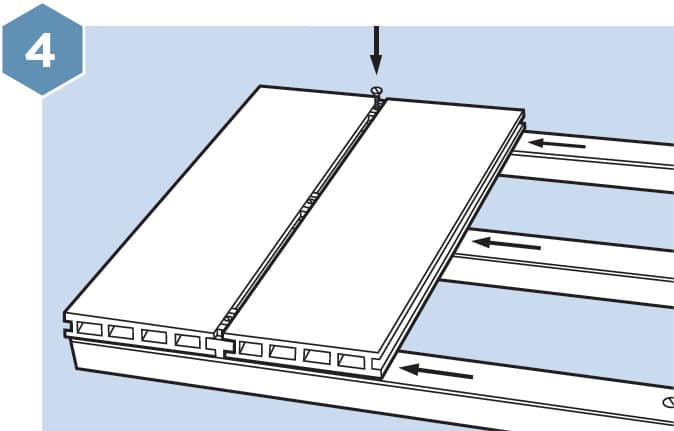
Take the next piece of HD Composite Decking and securely push into the clips. Now nip the screw to secure the clip against the board. Do not over tighten.
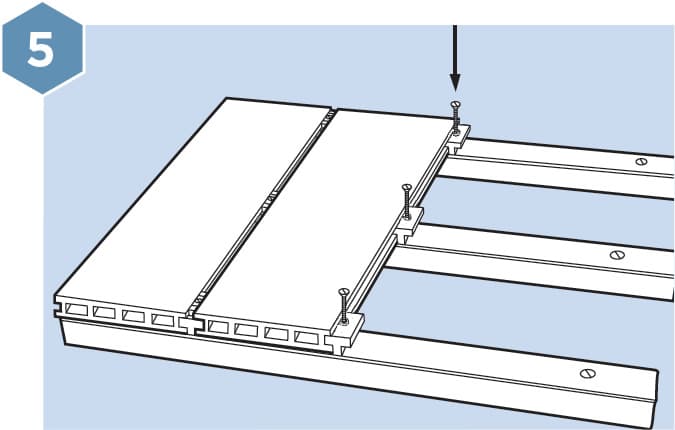
Now repeat steps 3 and 4 to cover the deck, using 1 clip and screw on every joist.
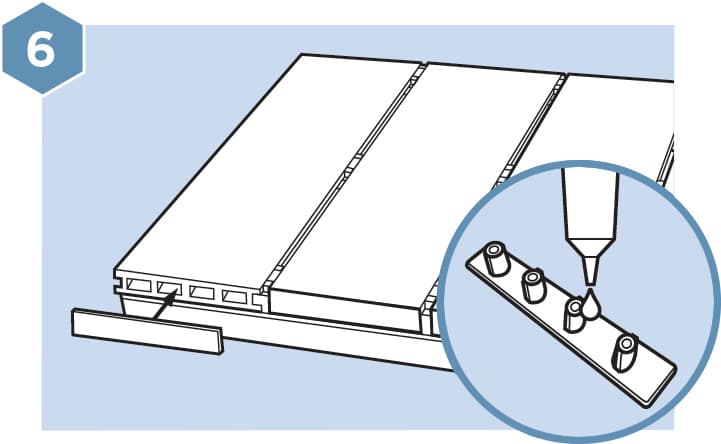
Liberally apply a high-quality grab adhesive to the end caps to secure for extra adhesion. Wipe away any excess from the edge of the cap.
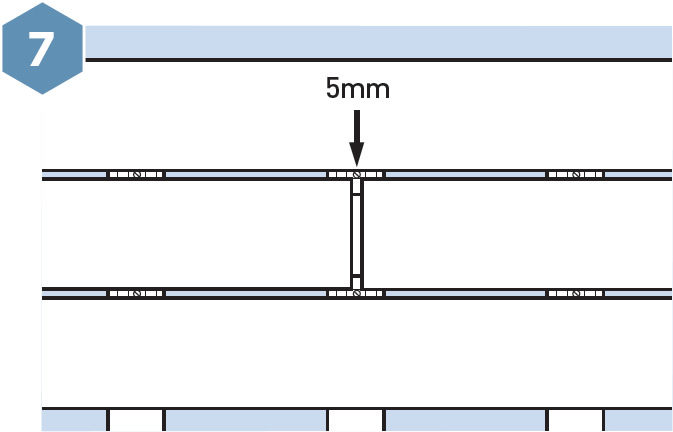
IMPORTANT: Do not allow HD Composite Decking boards to meet at the ends, at temperatures of 15°C or above allow a 5mm gap for expansion. Joins should only occur over joists with a clip securing each end. When fitting at temperatures below 15°C please refer to www.composite-prime.com.
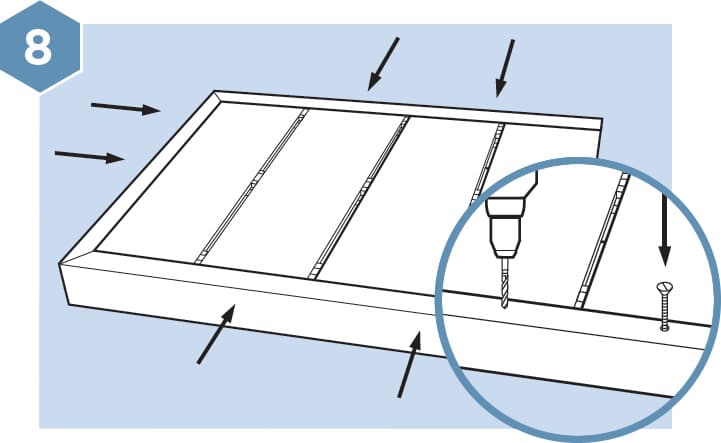
If using, take the Angle Beading Strip and place on the edge of the deck. Push up to the edge of the deck. Use a drill to first make a pilot hole through the beading and deck. Screw Angle Beading Strip into the joist through the first pilot hole. Drill more pilot holes as required and affix Angle Beading Strip with a screw.
Please Note: Images and drawings in this HD Composite Decking Fitting Guide are for illustrative purposes only. HD Composite Decking may be laid in a variety of patterns, we recommend that you draw out how you would like your deck to appear, making notes of joins and joists before starting the installation. It is not recommended that HD Composite Decking be installed in temperatures below 5°C. For elevated decks greater than 1.2 meters in height we recommend using a professional installer. When cutting, always saw the board face up with a fine-toothed blade to prevent furring the face edge.