


CATEGORY
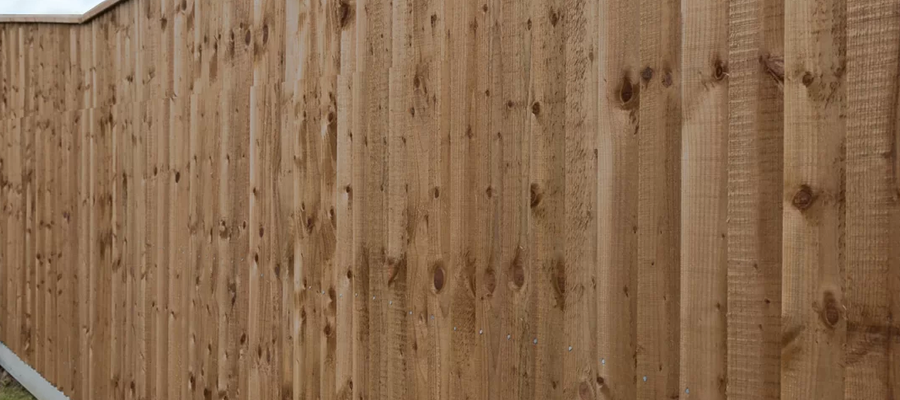
Building a garden fence is a DIY project that can transform your garden, offering privacy, security and a beautiful backdrop for your outdoor living. Among the various options available, feather edge fencing remains a favourite for its consistent look and exceptional durability. But one question still remains: how much overlap should you use when fitting feather edge boards?
Get it right, and you’ll have a strong, private, weather-resistant fence for decades to come. Get it wrong, and you risk a weaker structure with gaps that will shorten its lifespan.
In this guide, we’ll walk you through the perfect overlap for your feather edge boards, discuss the nail vs. screws debate and share pro tips to ensure your fencing project is a success.
Why Overlap Matters in Feather Edge Fencing
Feather edge boards are tapered, meaning one edge is thicker than the other. They should be installed with the thick edge overlapping the thin edge of the adjacent board. This system isn’t just for aesthetics, but is designed for performance.
A correct overlap delivers three key benefits:
- Strength – Overlapped boards share the load, so individual boards are less likely to loosen or crack in strong gusts.
- Privacy & Weather Resistance – The correct overlap prevents gaps from forming as the wood expands and contracts, ensuring you get the privacy you intended when building the fence.The overlap works like roof shingles—rain runs down the face of a board and over the next one, instead of into a vertical seam. Less water getting behind the boards means slower rot.
How Much to Overlap 125mm Feather Edge Boards?
The golden rule for how much to overlap a 125mm (5 inch) wide feather edge board is to aim for a consistent 25mm (or 1 inch) of cover.
This measurement is the sweet spot that provides ample coverage without being wasteful. Overlap too little, and you risk gaps appearing as the wood expands and contracts. Overlap too much and you’ll use more boards than necessary, increasing the cost and weight of the fence without adding any structural benefit.
Pro Tip – The easiest way to ensure a perfectly consistent overlap is to use a spacer. A simple 100mm off-cut of wood placed over the previous board will act as a foolproof guide, giving you a clean, 25mm professional overlap every time.
How Much Overlap on 150mm Feather Edge Boards?
For the less common 150mm (6-inch) wide feather edge board, a 30mm overlap is ideal. After the overlap, each board will contribute a net width of around 120mm to your fence. Wider boards are excellent for creating a robust, high-privacy fence with fewer individual boards, making the installation process quicker.
The Most Important Rule When Fitting Featheredge Boards
When you nail (or screw) your feather edge board, make sure that you nail slightly past the 25mm overlap, missing the board behind. This process will allow your boards to expand and contract without splitting.
Should You Use Nails or Screws for Fixing Feather Edge Boards?
Either option is acceptable. Nailing is much quicker and more economical; however, using screws can have a few benefits:
- Superior Holding Power – They provide a stronger, more reliable hold against wind pressure.
- Easier Repairs – If a single board gets damaged, it’s much easier to unscrew it and replace it without disturbing the neighbouring boards.
- Reduced Splitting – When you pre-drill a pilot hole (which is highly recommended when using screws on timber), you reduce the risk of splitting the thin feather edge.
If you choose screws, always opt for weather-resistant types. We recommend galvanised or stainless steel screws to prevent unsightly rust stains and ensure the longevity of your fixings. You can find a selection of the right fixings on our fencing accessories product page.
Step-by-Step Installation Guide
- Solid Foundations – Ensure your fence posts are secure, spaced at 3.0m apart and pressure treated for ground contact.
- Fix Your Arris Rails – Attach your horizontal cant rails to the posts. A three-rail system is standard for 1.8m and 2.0m high fences.
- Fix Your Gravelboard – Attach your 3.0m x 150mm timber gravelboard to the bottom of your posts. As well as providing extra strength and durability this provides a base for your boards to sit on, ensuring a perfectly straight top to your fence. Using a graveboard can also provide the extra height needed to achieve a 2.0m-high fence.
- If You Didn’t Fit a Gravelboard – Set A String Line – Run a string line along the top of the posts,. This will act as a guide to keep the top of your boarding perfectly straight.
- Start Fixing – Begin at your first post. Place your first board with the thick (butt) edge against the post. Use your spacer, then place the next board so its thick edge overlaps the first by 25mm.
- Work Your Way Across – Continue this process, using your spacer for each new board and checking for vertical alignment with a spirit level every few boards.
Common Mistakes to Avoid
Inconsistent Overlap – This is the number one aesthetic and functional error. It creates weak points and looks unprofessional. Make sure you use a spacer.
Skipping Treatment – If you’re using untreated timber, always apply a wood preservative to the cut ends and the entire board before installation. This is a critical step for durability.
Shop Feather Edge Boards and Accessories
Ready to start your fencing project? At Grangewood Fencing, we supply premium, pressure-treated feather edge boards as well as wide range of other high quality fencing products that are perfect for creating a strong, long-lasting fence. Our timber is sourced for quality and treated to resist rot and decay, giving you peace of mind for years to come.